






 I want to...






[Series 1] I live in Nagoya City. All my family members are healthy now, but I'd like to know the procedures to follow if someone from my family passes away in the future. What do I need to do?(名古屋市に住んでいます。今はみんな元気ですが、将来家族が亡くなった時の手続きについて知っておきたいです。)


2026.05.17
Q:
[Series 1]
I live in Nagoya City. All my family members are healthy now, but I'd like to know the procedures to follow if someone from my family passes away in the future. What do I need to do?
A:
Even if a foreign national dies in Japan, the same procedures need to be carried out under Japanese law (the Family Register Act).
1) File a Death Notification (Shibō-Todoke).
■What you need:
• Death Notification (You can obtain this form at a local government office, hospital, or funeral home.)
• Death Certificate (You can obtain this document at the hospital.) <*1>, or Post-mortem Certificate (You can obtain this document from the local police.) <*2>
• Identification document of the person filing the Death Notification (passport, residence card, etc.), and personal seal (if available)
<*1> Death Certificate: This is issued by a doctor when the person dies at a hospital and the doctor determines that the death was due to illness.
<*2> Post-mortem Certificate: This is issued by the police station in charge when the deceased person could not receive medical treatment from a doctor because the person died away from a hospital, or due to an unnatural or unexpected death.
■By when?: File these documents within 7 days of learning of the death.
■Who files?: A family member or other person who was living with the deceased, the homeowner, the landowner, or the person managing the house or land. Sometimes a funeral home files these documents instead.
■Where to file?: File these documents with a local government office in the area where the person died, or with the local government office of the city, town, or village where the person filing the documents lives.
2) Obtain a Burial Permit or Cremation Permit (Maisō Kasō Kyoka Shō).
Once you file the Death Notification and the procedures are complete, you will receive the Burial Permit or Cremation Permit.
This document is absolutely necessary in order to bury or cremate a body in Japan. Please be sure to obtain this document and do not lose it.
In Japan, cremation <*3> service is standard due to land and sanitation reasons.
Therefore, every region has a crematorium, and in most cases after a person dies, cremation takes place.
In Japan, burial <*4> services can only be performed in locations permitted by the prefectural governor. Burying the remains in an unauthorized location is punishable by law (crime of abandonment of a corpse).
If a burial service is preferred in accordance with the deceased person's religion or wishes, please consult with the relevant embassy, consulate, religious organization, local government, or community in advance. Furthermore, since there are few funeral homes that can handle burial services, it is important to carefully confirm whether it is possible beforehand.
<*3> Cremation service: The body is burnt and the ashes are placed into a container.
<*4> Burial service: The body is placed in a coffin without cremation and buried in the ground.
3) Return the residence card of the deceased person
■By when?: Return it within 14 days after the death.
■Where to return it?: Bring it to the immigration office responsible for your place of residence, or send it by mail to the address below.
• Please write "Return of Residence Card" on the front of the envelope.
Address: 2-7-11 Aomi, Koto-ku, Tokyo 135-0064
Online Inspection Department Odaiba Branch Office, Tokyo Regional Immigration Services Office, Tokyo Port Joint Government Building 9F
4) Contact the embassy or consulate of your country
Family members of the deceased person should contact their country's embassy or consulate as soon as possible.
The support you can receive varies from country to country.
Furthermore, the procedures differ depending on the deceased person's nationality and residence status.
Therefore, be sure to confirm the procedures with the embassy or consulate.
5) Procedures for canceling pension and health insurance, etc.
■By when?: Carry out the procedures within 5 to 14 days after the death.
■Where to carry out the procedures?
• If the deceased person was enrolled in National Health Insurance or the National Pension (self-employed or freelancer) → Contact the local government office of the city or town where the deceased lived.
• If the deceased person was enrolled in social insurance or an employee pension program (e.g., company employee) → Contact the company the deceased person worked for.
★ "Obituary counter" ★
In Nagoya City, each ward office has an "obituary counter."
This counter provides advice on all the necessary government procedures for the deceased and their family members (reservations are required).
Please see the Nagoya City website below.
https://www.city.nagoya.jp/kurashi/todokede/1007851/1034702/1008118.html
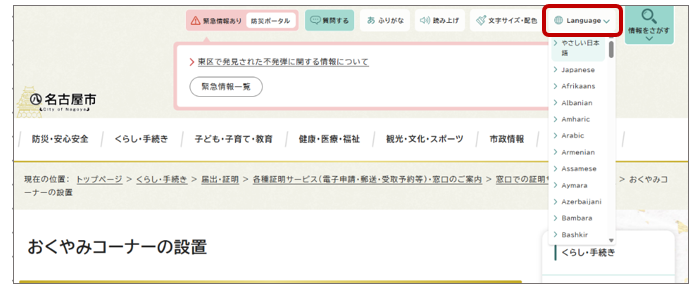
*You can select your language to view our website. Click "LANGUAGE" in the upper right corner.
★The next issue, June, will provide information on procedures in Japan other than those listed in 1) to 5), as well as procedures for sending the remains of a deceased person back to his/her home country.

